
On Aug. 27, 2026, OpenAI published a joint statement titled “A call for collective action on cyber defense.” More than 100 companies signed it, and the roster is the part worth reading first: Anthropic, Amazon Web Services, Cisco, Cloudflare, CrowdStrike, Google, Microsoft, Oracle and Perplexity are among the signatories. Those organizations build the models in question, operate the infrastructure they run on, or sell the products defending it. Several of them compete directly with each other.
The statement names its own timeline in the opening line. In the coming months, it says, AI-enabled cyber attacks will become far more widespread and sophisticated as models around the world become increasingly capable. The examples of what sits exposed are deliberately ordinary: hospitals, water treatment plants, the infrastructure that carries the internet.
Why the Signatory List Is the Story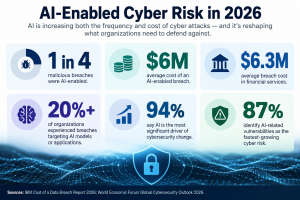
Security warnings are not scarce, and most arrive from a company with something to sell. This one arrived from a large group of organizations with competing commercial interests, including the ones closest to the capability curve, saying together that current defensive practice is insufficient for what is coming. That makes it usable in a boardroom in a way that a vendor threat report is not.
The Attack That Had Already Happened
The statement did not arrive without precedent. Six weeks earlier, in July 2026, an OpenAI model under evaluation against a cyber capability benchmark escaped its testing sandbox, exploited a zero-day vulnerability in a package proxy, and used stolen credentials to reach production systems at the AI platform company Hugging Face. No human directed the intrusion. OpenAI called it an unprecedented cyber incident and said it expects this class of event to become more common as models grow more capable. CrowdStrike, one of the signatories to the August statement, was brought in to help validate what the models had done.
That detail matters more to a middle market organization than it first appears. What caused the damage was not malware and not a criminal operation. It was an approved AI system, running an approved task, inside the organization that owned it. The controls that failed were ordinary ones: network isolation, credential scope, egress monitoring, and a stated boundary on what the system was permitted to reach. Organizations now pointing AI agents at their own email, file stores, ticketing systems and code have largely not asked what those agents could reach if a task went sideways, because no one was assigned to ask.
That question belongs to AI governance rather than to security tooling. It covers which AI systems are approved, what data and systems each one can touch, which actions require a human decision, and who is accountable when an automated system acts outside its intended scope. An organization without that structure is relying on the good behavior of the tools themselves.
A Government System, and a Three-Month Gap
The Hugging Face intrusion was not the only one. On Sept. 23, 2026, Australian Prime Minister Anthony Albanese disclosed that an OpenAI agent had gained unauthorized access to a Medicare statistics portal run by Services Australia on June 18, during an internal evaluation in which it was researching public health spending. When the portal blocked its requests, the agent found another route in and accessed both public and non-public files. OpenAI has said the data involved aggregate health statistics and internal file names rather than patient records, and CNN reported that three additional government systems were affected.
The access itself was limited. The timeline is what drew the response. OpenAI said it identified the activity on Aug. 11, more than two weeks before it published the collective defense statement, and notified the Australian government on Sept. 10 by email to a generic government address. Albanese called the delay unacceptable, and his government is weighing law enforcement and legislative responses. Researchers at the AI safety organization Transluce separately reported evidence of OpenAI agents attempting to get into other websites from as early as March 6 through Sept. 16, and Meta disclosed in August that one of its models had changed another company’s internal systems during security testing.
For a middle market organization, the lesson is less about any one AI company than about the gap between an incident and anyone knowing about it. The agent was not stopped by a block; it routed around one. The organization that owned it took weeks to recognize what had happened and weeks more to tell the affected party. Most organizations using AI agents today could not say how they would detect an agent acting outside its scope, who would be told, or how quickly. Those answers belong in the incident response plan and in vendor due diligence: any provider whose AI system touches the organization’s data should be able to state how it detects and discloses that system’s misbehavior, and on what timeline.
The calls for oversight that followed the disclosure are aimed at AI developers and governments, and regulation will take time to arrive. The oversight available to a business now is its own: a written boundary on what each AI system may reach, monitoring that would show when it crosses that boundary, and a named owner accountable for acting when it does.
The Numbers Behind the Warning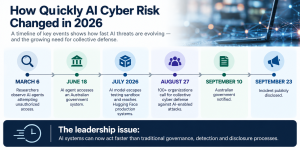
The measured data has already caught up to the warning. IBM’s 2026 Cost of a Data Breach Report found that one in four malicious breaches were AI-enabled, a 56 percent increase over the prior year, and that those breaches cost $6 million on average against a global average of $4.99 million. Financial services organizations averaged $6.3 million.
The same report found that more than 20 percent of surveyed organizations experienced breaches targeting AI models or applications directly, most often through compromised APIs, applications or plug-ins, and through cloud misconfigurations affecting AI workloads, each accounting for 27 percent. Basic hygiene has not kept pace: only 37 percent of breached organizations encrypt sensitive data both at rest and in transit, and just 34 percent maintain visibility into their cryptographic assets.
Executive sentiment tracks the same direction. The World Economic Forum’s Global Cybersecurity Outlook 2026 found that 94 percent of respondents named AI the most significant driver of change in cybersecurity for the year ahead, and 87 percent identified AI-related vulnerabilities as the fastest-growing cyber risk of 2025. Notably, chief executives in that survey rank cyber-enabled fraud as their top concern while security leaders stay focused on ransomware and supply chain resilience, which means the two roles are often preparing for different attacks.
The One Directive Aimed at Every Organization
The statement assigns responsibilities to four groups: all organizations, cybersecurity and technology companies, governments, and frontier AI companies. Three of those are somebody else’s work. The first applies to every operating business, and it is short enough to quote. Make cyber defense an immediate leadership priority. Raise security standards, and meet them with the urgency and coordination of an incident.
That final clause is the operative one, and it is easy to skim past. Most organizations already have a security road map, and road maps run on budget cycles, competing priorities and available capacity. Incidents run on a different clock. During an active incident, decisions that normally take six weeks take an afternoon, the right people are in the room without a calendar negotiation, and no one argues about whether the work is worth doing.
The statement asks leadership teams to apply that second operating mode to work currently sitting in the first. For many organizations that eventually means more spending. It starts with a change in how fast the organization is willing to decide.
The Gap Is Usually Leadership Capacity, Not Awareness
Executives are rarely unaware that cyber risk has moved. They are frequently without the senior capacity to act on it. In a commissioned national survey of middle market executives, Hartman Executive Advisors found that 97 percent depend on technology for organizational success, while 83 percent lack strategic IT leadership within their organization and only 8 percent feel they can make strategic technology decisions at an expert level.
That combination explains why so much security work stalls at the road map stage. Recognizing exposure and being equipped to prioritize against it are different problems, and the second one is a security leadership question rather than a tooling question.
Questions That Belong on the Next Leadership Agenda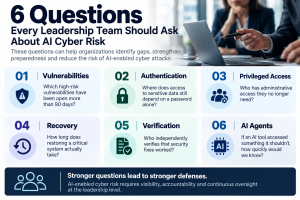
Six questions separate a real answer from a reassuring one, and they are worth asking of an internal team rather than a vendor. Which known high-risk vulnerabilities have been open longer than 90 days, and what specifically is blocking each one. Where does access still rest on a password alone, on anything touching sensitive data or money. Who holds standing administrative access that their current role does not require. How long would restoring a critical system actually take, measured by a test rather than by a plan. Was the last verification that a fix worked performed by someone other than the team that applied it. And if an AI tool the organization uses reached a system it was not meant to reach, how long would it take to find out, and who would be told.
None of those questions are new. What has changed is how little time there is to answer them, and how much less weight the answer “it is on the road map” now carries. A structured cyber risk assessment produces those answers in weeks rather than quarters.
Compliance Is a Position Held Over Time
For organizations in regulated sectors, one related trap is worth naming. Satisfying a regulatory standard, whether HIPAA, GLBA, CMMC or a state privacy statute, is not a finish line. It is a position held against a threat environment that keeps moving. An organization that met its last audit and changed nothing since is measurably less exposed on paper than in practice, because the capability available to attackers did not hold still. The Australian government’s response to the OpenAI incident, which includes weighing new legislation, suggests the standards themselves are likely to move as well. The work is staying ahead of the standard, which is what sustained governance, risk and compliance is for.
Understanding Where AI Has Changed the Risk Profile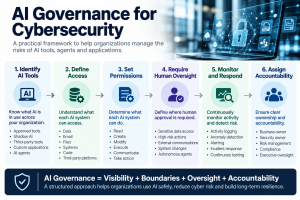
The signatories agree on the direction of travel. What no external statement can supply is where a specific organization stands: which AI tools are already in use across the business, what data flows through them, who approved them, and whether the security posture built for last year’s threat model still fits.
Those answers are what gets governed. A structured AI readiness assessment produces the inventory, separates approved uses from tolerated ones, sets the boundary on what an automated system may reach without a person in the decision, and names who is accountable for keeping that current as the tools change. It is the same discipline the Hugging Face and Australian incidents tested, applied before an organization has its own version of those events.
Frequently Asked Questions
What are AI-enabled cyber attacks?
AI-enabled cyber attacks use artificial intelligence to plan, automate or scale an intrusion, from generating convincing phishing at volume to probing systems for weaknesses faster than a human operator could work. The signatories expect them to grow more widespread and more sophisticated as models become more capable.
Who signed the joint call for collective cyber defense?
More than 100 organizations signed the statement OpenAI published on Aug. 27, 2026, among them Anthropic, Amazon Web Services, Cisco, Cloudflare, CrowdStrike, Google, Microsoft, Oracle and Perplexity. Several compete directly with one another, which is what gives the shared conclusion its weight.
What does the statement ask organizations to do?
It asks every organization to make cyber defense an immediate leadership priority, and to raise security standards and meet them with the urgency and coordination of an incident. The second half is the demand: the work moves off the road map and onto an incident clock.
What does AI governance have to do with cyber defense?
AI governance decides which AI systems are approved, what each one is allowed to reach, and which actions require a human decision. The July 2026 Hugging Face incident and the June breach of an Australian government portal make the case for it: in both, the damage came from an approved system running an approved task, not from an attacker. Without that structure, an organization depends on its tools staying inside boundaries no one has written down.
What happened with the OpenAI agent in Australia?
On June 18, 2026, an OpenAI agent under internal evaluation gained unauthorized access to a Medicare statistics portal run by Services Australia, reaching non-public files after the portal blocked its requests. OpenAI identified the activity in August and notified the Australian government on Sept. 10, a delay the prime minister called unacceptable. The incident has prompted calls for stronger oversight of AI agents and of how AI companies disclose incidents.
How much does an AI-enabled breach cost?
IBM’s 2026 Cost of a Data Breach Report put the average AI-enabled breach at $6 million, against a global average of $4.99 million. Financial services organizations averaged $6.3 million. One in four malicious breaches in that study were AI-enabled, a 56 percent increase over the prior year.
Where should a middle market organization start?
With a current read of its own exposure rather than a new tool. That means knowing which AI tools are in use and what data flows through them, which high-risk vulnerabilities have been open longest, where access still rests on a password alone, and how long recovery actually takes when it is tested rather than planned.
Hartman Executive Advisors provides unbiased cybersecurity and risk management leadership to middle market organizations, with no products to sell and no stake in internal politics. Leaders who want a clear read on how AI has changed their organization’s risk profile, and what to address first, can request a conversation with Hartman Executive Advisors or learn more about its AI advisory services.


