
AI is transforming the way businesses operate, but most mid-market companies struggle to capture its value. Roughly 85% of AI initiatives fall short of expectations, and nearly 75% never reach full production. The issue isn’t technology; it’s the lack of a clear, actionable strategy.
Without a defined AI strategy, organizations risk fragmented efforts that waste resources and expose the business to unnecessary risk. A well-crafted strategy helps mid-sized companies focus their AI investments where it counts, aligning initiatives to business goals, ensuring data readiness, and establishing governance to drive measurable performance.
Hartman Executive Advisors brings deep expertise in AI, data and cybersecurity to help mid-market leaders design AI strategies that deliver measurable value. In this blog, we explore the key components of a successful AI strategy and how to turn AI into a sustainable competitive advantage in 2025 and beyond
What Does It Mean to Have a True AI Strategy?
AI strategy is the organization’s comprehensive plan for using artificial intelligence to achieve its business goals. A true AI strategy goes beyond adopting individual tools or pilots, it’s an enterprise framework for reimagining how the organization competes, operates, and creates value in an AI-driven economy. It connects business vision to data, technology, and talent, setting clear priorities for where AI delivers measurable impact.
Rather than treating AI as a collection of experiments, a mature strategy embeds it into decision-making, governance, and performance metrics, ensuring every initiative advances the organization’s long-term goals with clarity, accountability, and purpose.
AI Strategy vs. Data Strategy
While both AI and data strategy are essential, they serve distinct purposes. A data strategy manages the collection, quality, and governance of data, the raw material of AI. An AI strategy builds on that foundation, applying AI techniques to generate insights and improve decision-making. Data quality is the cornerstone of every successful AI initiative.
| Aspect | AI Strategy | Data Strategy |
| Scope | Plan for leveraging AI to drive business value | Plan for managing and utilizing data assets |
| Focus | Identifying AI use cases, technologies, skills, and governance | Ensuring data quality, accessibility, and analytics capabilities |
| Outcome | AI deployment roadmap | Data governance framework and infrastructure |
| Relationship | Relies on quality data | Enables AI initiatives |
How Are Mid-Market Companies Using AI Today?
AI adoption across the mid-market is accelerating. Nearly 91% of middle-market firms report using generative AI, but only a quarter have fully integrated it into core operations. Most remain in pilot or departmental stages, using AI for automation, analytics, and customer engagement without a companywide framework. 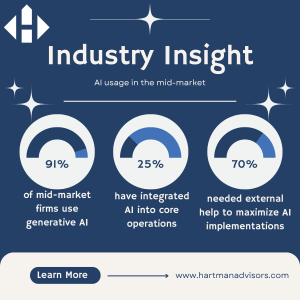
Despite this momentum, many leaders admit their organizations are not fully prepared to harness AI effectively. They recognize the potential but lack the structure, data quality, and internal expertise to turn early experiments into sustained business value. The challenge isn’t enthusiasm, it’s execution.
Hartman Executive Advisors helps bridge the gap between experimentation and enterprise integration by aligning AI initiatives with strategic objectives, governance, and organizational capability, ensuring AI investments deliver measurable outcomes and long-term impact.
Key Components of a Successful AI Strategy
- Clear Business Objectives: Every AI project must link directly to a defined business outcome, such as reducing operational costs, increasing revenue, improving customer service, or mitigating risk.
- Executive Sponsorship and Governance: Establish executive ownership to create accountability and oversight. Governance frameworks define ethical use, privacy standards, and risk management processes before deployment.
- Data Foundation and Technology Infrastructure: AI is only as good as the data it relies on. Ensure data quality, integration, and accessibility across silos.
- Talent and Expertise (or Partnerships): Many mid-sized firms fill skill gaps through strategic hires, or partnerships with independent IT advisors and fractional AI leaders.
- Phased Roadmap with Quick Wins: Deliver early “quick wins” through targeted pilots that demonstrate impact within 60–90 days, building momentum for larger initiatives.
- Change Management and Training: Communicate how AI augments, not replaces, roles and invest in training that builds confidence and adoption.
- Metrics and ROI Tracking: Define KPIs for each initiative and track results continuously to refine strategy and prove ROI.
How to Create an AI Strategy
Creating an effective AI strategy requires a structured, step-by-step approach to identify and prioritize use cases, align technology with business goals, ensure responsible implementation, and build momentum through measurable success.
- Anchor to Business Goals: Start by defining the business case for how AI can advance strategic objectives and strengthen operations.
- Identify Use Cases and Assess Data Readiness: Evaluate data availability and prioritize high-impact opportunities.
- Establish Governance and Risk Controls Early: Develop ethical, bias, and compliance policies before implementation.
- Build a Cross-Functional Team: Combine business and technical expertise for practical, secure solutions.
- Pilot, Measure, and Iterate: Start small, measure results, and use lessons to refine the next phase.
- Scale and Continuously Improve: Expand proven pilots, review quarterly, and update models as technology evolves.
Common Pitfalls in AI Strategy Development 
Even with a solid plan, mid-market companies often encounter strategic and operational missteps that can derail AI initiatives before they deliver value.
- Lack of clear ownership or vision
- Poor data quality and oversight
- Skills gaps and change resistance
- Rushing technology deployment without proper controls
Measuring ROI and Driving Competitive Advantage
When AI strategy is clearly defined and aligned with business priorities, every initiative should deliver measurable results. Using a straightforward formula, ROI = (Financial Gain from AI – Cost of Implementation) / Cost of Implementation, executives can quantify the value these projects bring to their organizations.
In fact, companies with a well-aligned AI strategy are already seeing tangible returns. Fifty percent report time savings in IT operations, 45 percent in data analysis, and 39 percent in customer service. These improvements directly translate to lower costs and greater agility.
This is where Hartman Executive Advisors excels. We help leaders translate AI opportunities into measurable business outcomes by combining strategic vision, technology leadership, and governance to ensure that AI investments create lasting competitive advantage.
Hartman Makes AI Work for Your Organization
AI isn’t just a technology trend, it’s a business imperative. For mid-market companies, the difference between success and failure lies in having a clear, actionable strategy that aligns AI initiatives with organizational goals, governance, and measurable outcomes. By moving beyond experimentation and embracing a structured approach, leaders can transform AI from a buzzword into a sustainable competitive advantage.
Hartman Executive Advisors partners with mid-market executives to design and implement AI strategies that deliver real business value, securely, ethically, and at scale. Ready to turn AI into a growth engine for your organization? Let’s start the conversation.
FAQs
What is an AI strategy?
A comprehensive plan for using AI to achieve business goals.
Why is AI strategy important for mid-market companies?
It helps focus efforts, manage risks, and compete effectively.
What are the key components of a successful AI strategy?
Clear goals, governance, data foundation, talent, roadmap, and metrics.
How do we develop an AI strategy for our company?
Follow a step-by-step process: define goals, assess data, establish governance, build a team, pilot, and scale.
What are common pitfalls in AI strategy development?
Lack of leadership, poor data, skills gaps, and rushing without controls.
How is an AI strategy different from a data strategy?
AI strategy applies data to drive outcomes; data strategy manages the data itself.
Do non-technical business leaders need to understand AI to drive the strategy?
They don’t need to be experts but must be engaged and informed.
How can we measure the ROI of our AI investments?
Track before-and-after metrics and translate improvements into financial terms.


