
As mid-market organizations grow, technology decisions become more complex and critical to business success. Concerned that hiring an experienced IT executive can be expensive, time-consuming, and risky, many companies are making the strategic decision to hire a fractional IT leader or outsource to a virtual CIO (vCIO). While both offer a more economical and flexible approach than a full time hire, the depth of integration, accountability, and independence they bring to the business are vastly different.
A fractional IT leader is a part-time, senior-level executive who works as an integrated part of a company’s leadership team to provide proactive, strategic guidance, while an outsourced vCIO typically refers to an external company or service provider like a Managed Service Provider (MSP) that handles day-to-day administrative IT tasks and is more reactive in nature.
Read on to learn more about these models and how understanding their differences can help you choose the right approach to align technology leadership with your company’s growth goals.
What Is Fractional IT Leadership?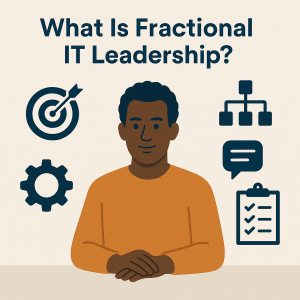
A fractional IT leader is an experienced technology executive, typically a CIO, CISO, or CTO, who is embedded into your leadership team. This executive is not an outside consultant; they are an accountable member of your leadership team, responsible for driving organizational goals through technology strategy, governance, and execution.
The fractional leader does what is required to move the organization forward, guiding strategy, managing IT staff and vendors, advising executives, and aligning technology with measurable business outcomes.
Fractional IT leadership is not outsourcing; it’s insourcing expertise. Instead of packaging up your IT leadership needs and sending them outside the organization, you are adding strategic capability to your team. The fractional IT leader becomes an internal force multiplier, empowering your people, building IT maturity, and expanding what the organization can achieve from within.
A fractional IT leader adopts your systems, culture, and communication style. They work within your existing workflows and tools like project management systems, collaboration platforms, reporting structures, and internal language. They attend staff meetings, company events, and planning sessions as one of your own. This integration allows them to lead change from within, not from the outside.
At Hartman Executive Advisors, fractional IT leaders are engaged in five key areas:
- Strategic Business and IT Alignment
- Team Leadership and Development
- Governance and Execution
- Cultural Integration
- Executive Reporting
Hiring an Individual vs. a Fractional IT Leadership Firm
Another important distinction lies in who provides the service. Engaging an individual fractional IT leader is very different from engaging a fractional IT leadership firm.
When you hire an individual fractional CIO, you gain access to that person’s unique experience and perspective. However, modern IT leadership requires a diverse range of expertise, including security, data, AI, infrastructure, software selection, change management, and project delivery. No single individual can fully cover that spectrum.
When you work with a fractional IT leadership firm, you gain not only your dedicated CIO but also the collective expertise of an entire team. At Hartman Executive Advisors, this includes CISOs, CTOs, and specialists in data strategy, AI, software systems, project management, and change management. That depth of knowledge means your organization benefits from a team-based approach with access to experts as you need them. This allows companies to compliment the skills of their existing IT staff and vendors without hiring more FTEs.
What Is a vCIO?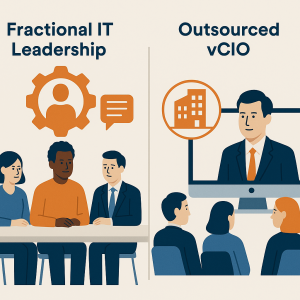
A vCIO (virtual CIO) is commonly offered by Managed Service Providers (MSP) and IT consulting firms as part of an IT services contract. The vCIO provides limited strategic oversight, often within a defined time block each month, focusing on tactical planning and infrastructure support.
The vCIO model is a form of outsourcing the CIO role. Rather than expanding your organization’s capabilities, you’re delegating them externally. The vCIO remains aligned with the MSP or consulting firm’s service model, meaning their scope and priorities are driven by the provider’s capabilities rather than your internal growth strategy.
By outsourcing the CIO role, your organization also takes on the MSP’s tools, processes, and methods of communication. Your team interacts through their ticketing systems, dashboards, and management platforms, operating within the provider’s ecosystem rather than your own. This creates distance between the vCIO and your company’s day-to-day culture, language, and workflows.
The Importance of Unbiased Leadership
One of the most important factors to consider as you evaluate any leadership approach is independence. Working with a vendor-agnostic firm means that every recommendation is made solely in your organization’s best interest, focused on what will drive business value, not what will generate revenue for a provider. You want an unbiased CIO who sits on your side of the table to help you make the right decisions for your business, not for their business.
Innovative Ways CEOs Are Filling Leadership Gaps
The future belongs to organizations that can access the best talent in the most efficient and effective ways possible. In a recent survey, 72% of CEOs indicated they plan to increase their use of fractional executives within the next 12 months, and organizations report 40–60% cost savings compared to full-time hires while maintaining strategic impact.
The rise of fractional leadership marks a fundamental shift in how organizations access and deploy executive talent. In an era defined by rapid change, complexity, and constrained resources, fractional executives provide the agility and expertise companies need to stay competitive. This unique leadership approach is a strategic evolution that enables leaders to build more resilient, high-performing organizations.
Contact us today to learn how Hartman’s fractional IT leadership model delivers enterprise-level expertise, cost savings, and results for mid-market organizations.
Frequently Asked Questions
1. Is fractional IT leadership only for companies without a CIO?
No. Many organizations with internal IT leaders engage a fractional CIO or CISO to provide executive-level oversight, mentorship, and strategy development, particularly during times of growth, transition, or restructuring.
2. How is a fractional IT leader different from a consultant?
Consultants provide advice and recommendations within a defined scope. A fractional IT leader is accountable for execution and outcomes, operating as an ongoing member of the leadership team to implement strategy, build governance, and deliver results.
3. Can a fractional IT leader work alongside an MSP?
Yes. Many Hartman fractional CIOs work closely with MSPs.
4. What is the difference between hiring an individual fractional CIO and engaging a fractional leadership firm?
An individual offers their own skills and experience, while a firm brings depth and access to multiple executives and specialists (CISOs, CTOs, data strategists, project managers). You gain a broader bench of expertise at a fraction of the cost of hiring full-time staff.
5. How much time does a fractional IT leader typically spend with a client?
Engagements vary based on needs, but fractional leaders operate on a results-based model. They dedicate the time necessary to deliver measurable business value, not to fill a timesheet.
6. What size organizations benefit most from fractional IT leadership?
Mid-market organizations, those large enough to require executive-level IT strategy but not ready for a full-time CIO, gain the most value. These leaders bring enterprise-class strategy at a scalable cost.


